Overview
This page is organized around three overarching strategies that I use in my teaching to facilitate learning around topics that challenge deeply held assumptions and investments in violent institutions, such as the carceral state. Below each strategy is a list of supporting sample materials that I use. All of the below linked materials are also accessible through this Google Drive folder.
I have only been able to develop these materials thanks to the work of numerous abolitionist organizers and scholars who I am indebted to. These materials are currently and forever a work in progress, so I would love to hear strategies of how others approach teaching abolition or similar topics in the classroom and continue to collaboratively build out these materials (contact me).
I am grateful for early feedback on these materials provided at the 2023 UW Women’s and Gender Studies Consortium Conference and by my fellow panelists of, “Phoenix Rising: Cultivating Intersectional Feminism in Northeast Wisconsin.”


Something that crosscuts all of these strategies: check-ins with students, especially students who may be especially impacted by topics we’re covering in the class (e.g., pre/mid/end-semester surveys, post-discussion self-assessments, and follow-ups).
The Future of Policing (final project)
Examples of previous students’ projects (shared with permission)
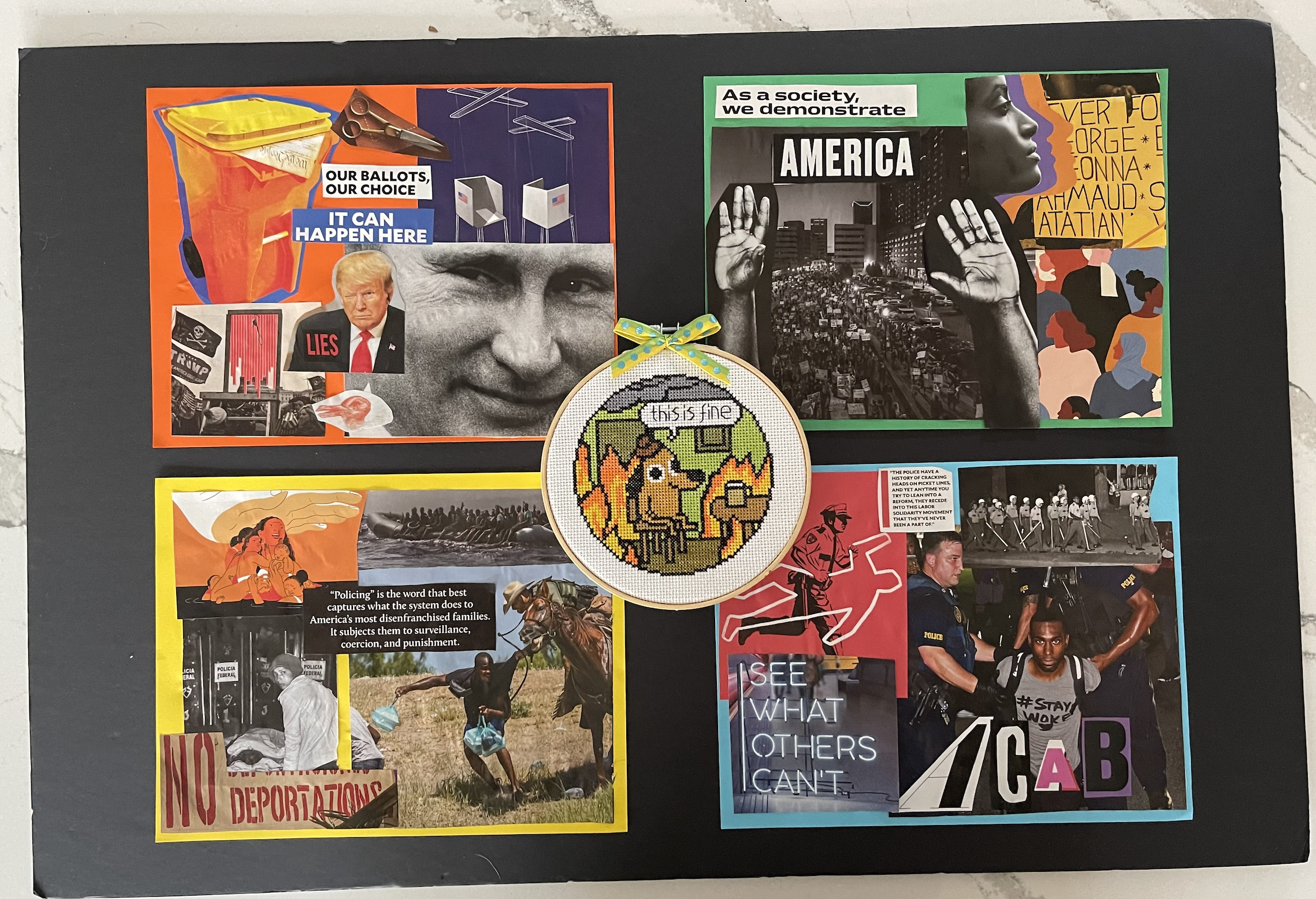
Collage on the Future of Police
Podcast on Policing in the U.S. and Norway
Website on Defunding the Police
Infographic on Future of Policing in New Zealand and U.S.
Zine on Mexican and British policing: “Military or Police – What’s the Difference?”
Poster on Police in the U.S. and South Africa: “The Division Between the Police and the People”
Infographic on Policing in the United States and Norway
Instructions
The final project for this course will take the form of a zine, poster, exhibit, illustration, social media campaign, or another creative format of your choosing. If you would like to present your project as a recorded video, podcast, or dialogue, you are welcome to; but challenge yourself to go beyond the classic slideshow-based presentation.
- Here are ideas and examples for inspiration: Project NIA toolkits and zines; Interrupting Criminalization publications and art; Abolitionist Tools graphic notes and slides; MPD150 comic; Critical Resistance resources (from this last link, you can filter by type in the right-hand toolbar once you scroll all the way down: art, checklist, factsheet, flyer, infographic, interview, multi-media, study and resources guides, toolkit, zines, comics, pocket guides- all of these formats would be acceptable for this project).
You will begin this project by presenting the main insights from your global politics of policing essay (i.e., your answers to the previous prompts here). Build on these insights to answer the question, what can you imagine as the future of the police and policing in these contexts? You should cite and engage with ideas from the final section of the course on organizing for democracy, problematizing reform, abolitionist alternatives, and transformative justice. There are no right or wrong answers in this project. I will be looking for how effectively you’re able to use critical thinking skills, synthesize learning materials and discussions from the semester, and be creative in your imagining of a more just future.
In your project proposal, please include the following:
- What will be the format of the project?
- Summarize your answers to the main three questions from your GPOP essay (this may serve as the introduction or framing of your project):
- How does the police and policing work in your two selected contexts?
- How did the police and policing emerge in these two contexts?
- What does the police and policing look like in these two contexts today?
- Based on your answers and analysis of the above questions, what can you imagine as the future of the police and policing in these contexts?
- Some tips of how to get started thinking about this: hypothesize the root causes of the problems, connect the dots between historical legacies and their contemporary manifestations, consider attempted changes and the role of social movements, etc.
- Which sources and ideas do you find fruitful for your thinking about this future?
- Hint: revisit the final unit’s modules on democracy, problematizing reform, abolitionist alternatives, and transformative justice
 Kaden Paulson-Smith